Nephite defensive-war doctrine
Book of MormonNephite defensive-war doctrine is the principle that legitimizes armed conflict only as necessary defense of the community and its covenantal way of life. The doctrine permits resistance, even to the shedding of blood, when enemies threaten families, homes, liberties, country, or religion, while sharply distinguishing that duty from warfare pursued for monarchy, power, ambition, or the pleasure of violence. Its central paradox is therefore deliberate: violence may be permitted, but it must remain subordinate to preservation, obedience, and the hope that the enemy will not prevail.
Definition and Moral Limits
The doctrine emerges in a setting where the Lamanites fight with extraordinary strength and courage, yet the Nephite cause is presented as morally different. The Nephites are not described as contending for monarchy or power. Their stated grounds are their homes and liberties, their wives and children, and their church. This contrast makes political purpose decisive: the same battlefield action can appear either as aggression or as defense depending on what the fighters seek to preserve and what authority they claim for their action.
The doctrine rests on an explicit duty to defend families even unto bloodshed. That command does not make killing an unrestricted right. It establishes a threshold of necessity: the Nephites contend because they are defending themselves and because surrender would expose the community to destruction or bondage. The moral warrant lies in protection rather than acquisition. War is consequently framed as an emergency obligation imposed by threatened relationships and communal responsibilities, not as an arena in which rulers or soldiers may enlarge their honor.
Political and Religious Background
The doctrine gains force from the political instability surrounding the Nephite community. The people once express a desire for Aaron to become their king and ruler, showing that monarchy remains an available political aspiration. Against that possibility, defensive warfare is defined as resistance to domination rather than a means of establishing it. The doctrine can support the defense of a free people, but it cannot easily justify fighting to create or preserve monarchy for its own sake.
Its religious setting is equally important. Unbelief is associated with hardened hearts and an inability to understand the word of God, while the community’s religious life depends on disciplined teaching, priestly administration, and the exclusion of iniquity. The doctrine therefore does not stand apart from worship and moral formation. The church, its commandments, and the people’s duty before God all become part of the reason for resistance, while the same religious order limits the violence undertaken in its name.
Application in War
In battle, the doctrine gives the Nephites a cause broader than military victory. Their struggle includes the defense of homes, liberties, families, and religion, so defeat would mean more than the loss of territory. The stakes include the disruption of domestic life, political freedom, and communal worship. This explains why the narrative can acknowledge the courage and ferocity of the Lamanite armies while still presenting the Nephite fighters as inspired by a better cause: their courage is attached to preservation rather than conquest.
The doctrine also governs the treatment of defeated enemies. When prisoners of war cast down their weapons at the feet of the Nephites and plead for mercy, Moroni takes them prisoner, takes possession of the city, and retains them rather than treating surrender as an invitation to indiscriminate slaughter. Mercy does not erase the conflict or the military consequences of defeat, but it demonstrates that the purpose of defense is compatible with restraint once the immediate threat has been neutralized.
Moroni as Its Representative
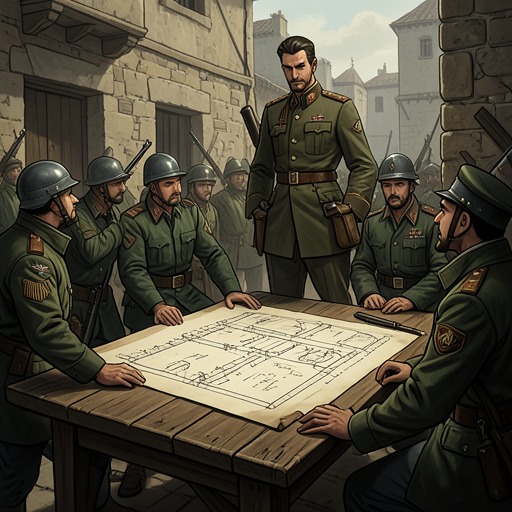
Moroni embodies the doctrine in both his public oath and his inward purpose. He is firm in faith in Jesus Christ and swears to defend his people, rights, country, and religion, even at the cost of his blood. The oath joins political and religious obligations without reducing either to personal ambition. His own life becomes the pledge that defense requires sacrifice from the protector before it demands sacrifice from the protected.
Yet Moroni’s faith does not glory in the shedding of blood. His heart glories in doing good, preserving his people, keeping the commandments of God, and resisting iniquity. This distinction is the doctrine’s ethical center. A commander may enter war while refusing to make war itself an object of devotion. Military success is acceptable only insofar as it serves preservation and righteousness; bloodshed remains a tragic instrument, never the measure of virtue.
Institutional and Narrative Significance
The doctrine creates a boundary between legitimate public force and corrupt forms of power. Priestcraft is condemned when religious authority is used for personal advantage, and secret combinations operate through signs and secret words that distinguish members bound by hidden covenants. These alternatives reveal what defensive war must not become: a private system of power concealed within public institutions, governed by loyalty to an inner brotherhood rather than by accountable obligations to the whole community.
The doctrine also belongs within a larger order of communal discipline. Church elders and priests administer sacred practices, and the church is strict about iniquity, bringing those condemned by three witnesses before the elders. Such procedures suggest that the community’s legitimacy depends on visible standards and collective accountability rather than on the unchecked will of a ruler or military leader. Defensive force is therefore one part of a wider moral and institutional system, not a substitute for judgment, worship, repentance, or communal correction.
Its lasting narrative significance lies in the tension it refuses to resolve cheaply. The Nephites may fight, and they may fight unto bloodshed, but they are repeatedly required to explain why they fight, whom they protect, and what they must refuse to become. The doctrine permits force under pressure while placing force under judgment. In that structure, the true test of the defender is not eagerness to destroy an enemy, but the ability to preserve a people without turning preservation into domination.